The PBL Math playbook

How do we do PBL Math?

Four principles, one core formula, and a working example. The goal isn't fancy — it's retention through real, repeated practice inside something students actually want to make.

The core formula
Repetition + Rigor + Relevance = Retention
The four principles

How to design a project that works.

These are the four questions to ask yourself when you sit down to design a unit.

01

Make it as real and relevant as possible.

Students engage when they see the project connects with them. When projects have enough personal autonomy, students value their work — and it won't be trashed afterwards.

"When will I ever use this in my life?"
02

Repetitive use of content creates the product.

Start with a standard or group of standards. If you would normally assign 40 problems for practice, design the project so students hit that concept the same number of times — or more.

"How can students repeatedly use this concept to create a product?"

03

Don't be afraid to think BIG.

Think outside the box, take calculated risks, set up guest speakers, teach above grade level when needed, learn a new skill yourself if you have to.

"How far can the students take this project?"

04

Have an example of what excellence looks like.

Doing your own project — especially a new one — surfaces every pitfall students will hit. After a few years, you'll have a library of exemplary work. At the very least, do the project alongside them.

"What exemplary work do my students have to model after?"

Worked example

A project on fractions, designed in 60 seconds.

Standard: Operations with fractions

Project idea: Read, write, and play music. Watch how the principles cascade:

  1. Notes are fractional. Have students dissect a popular song like Twinkle, Twinkle. What are the numerical equivalents of each note? What do they notice about the sum of notes in each bar? (repetition)
  2. Move on to longer songs with more varied fractional notes. (more repetition)
  3. Have students write their own songs with requirements: a certain number of halves, quarters, eighths, sixteenths. (personal autonomy + repetition + rigor)
  4. Require a certain number of bars. Discuss how loudness relates to amplitude — which relates to multiplication of fractions. Bring in string instruments and demonstrate harmonics. (rigor)
  5. Discuss octaves. Show how strings tuned to the same notes resonate. Show the Pythagorean music scale uses fractions. (rigor)
  6. Finally — have students play their music. Bring in a keyboard. Or have a computer play it. Or have it performed by professionals. What if students write parts for multiple instruments? (think BIG) Remember to complete a full version yourself as an example.
Calibrate your expectations

What PBL is — and isn't.

A trifold or a slide deck isn't a PBL project. Here's a quick checklist for the difference.

✕ PBL is NOT

What gets called PBL but isn't

  • The trifold
  • The webpage
  • The PowerPoint or slide show
  • A product without drafts, processes, and real math
  • 80% fluff, 20% math (in content, time, OR grading)
  • A classroom of projects that all look exactly alike
  • A project where you have to "look for the math"
  • Work you're not proud to publicly display
  • A project students can't wait to trash
  • Where you have to reteach the topics after
✓ PBL IS

The real thing

  • Oozing with math
  • Full of numbers, equations, graphs, calculations
  • Drafts, processes, reviews and critiques — and lots of math
  • Built on a design cycle
  • 20% fluff, 80% math (in content, time, AND grading)
  • Unique to each student's interests
  • The kind of work that makes someone say "there's that much math in that?!"
  • Something to be publicly displayed
  • Something students want to keep
  • Achieving learning and retention in infinitely many ways
For your second project

How to get better at PBL.

Six things to do once you've run your first project and want the next one to be sharper.

1 Try something — anything.

Start small. A week-long project where students create a mosaic tile display using multiplication tiles (just their 3s). Assign colors to each multiplication fact. Have them make 9 sets with the product written on each tile (repetition). Let them rearrange into different designs (drafts) until they finalize one. Ask why they chose their final design. Have them document the process — the drafts, the calculations, how multiplication relates to the length, width, and area of a tile. Extend into art with color swatches and complementary colors. At the end of the day: "put the go to the know."

2 Collaborate with people of different strengths.

Different people bring different strengths to project design:

  • Ideation — people who can take a boring topic and turn it into an exciting idea
  • Connectors — people who can connect math to art, science, cooking, music
  • Strategic — people who can build a logical project plan
  • Achievers — people who want to see success and encourage everyone forward
  • Creators — people who get their hands dirty and show rather than tell

Don't do it alone unless you have most of these strengths yourself.

3 Be aware of the math around you.

Math is all around us. Look for ways to incorporate the world into math. Even if it's a single lesson, it will plant a seed of ideas that may flourish into a week-long or month-long project.

4 Be aware of your students' interests.

Figure out what your students like. Design projects with that in mind. When I taught fractions to a group of students in a remedial class who were three years behind, traditional methods weren't getting through. But I noticed they had earbuds in all the time. I rewrote the entire semester around music — they read music, wrote music, played music, even built their own guitars from scratch. I took music classes and learned guitar myself (I had no music background). By the end of the year, the class went from 0% to 86% passing the standardized test.

5 Bring in your own interests.

We teach what we're most passionate about. If it's gardening, figure out how math is repeatedly used. Whatever your interest, students will see how excited you are. At two schools, I managed to get a pool table into my classroom — and taught a lot of math on it. Another hobby of mine is art, which is why so many of my projects center on it.

Bring in your interests, and students will get to see the human side of you.

6 Recycle, redesign, refine.

If a project was a success, recycle it — meaning take it through the redesign stages again. If we ask students to learn the design cycle and create drafts, we should do the same with our project designs. Right after a project ends, figure out the pitfalls. Survey your students: what worked, what didn't, what would they change? Refine based on the data and your own observations to make next year's run more efficient.

Reference

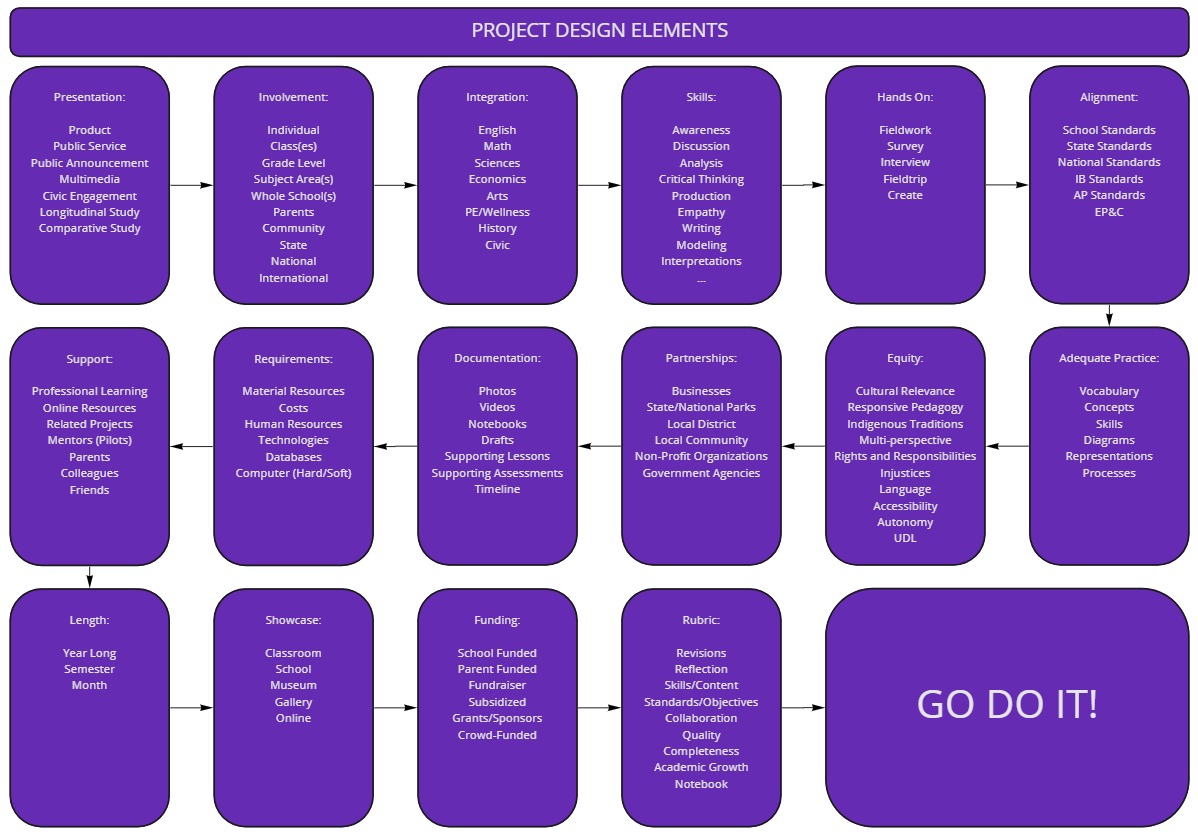
My design flow.

The full process I run when designing a new project from scratch.

Project Creation Design Process diagram
Next step

Pick a lesson. Run it next week.

The fastest way to learn PBL is to try it. Start with one of the lessons here — and remix from there.